
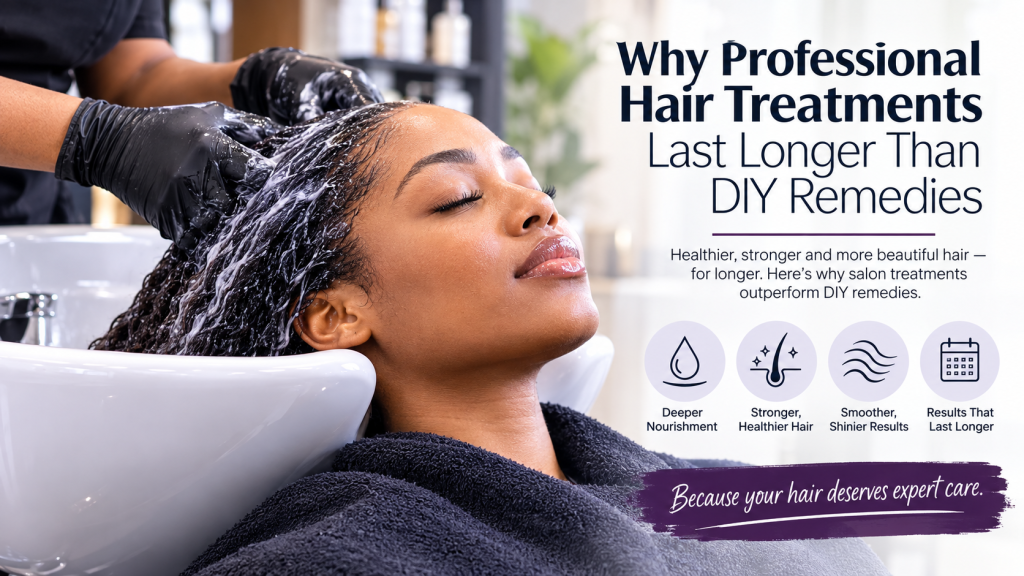
You can apply a hair mask at home and enjoy softer, shinier hair by the end of the evening. So why can a salon treatment sometimes keep your hair feeling smoother and more manageable for considerably longer?
The difference isn’t simply that professional hair treatments use more expensive products. A good salon treatment combines the right formulation with an assessment of your hair, controlled application, correct processing and professional aftercare advice. DIY remedies still have an important place in your routine, but they aren’t always designed to solve the same problem.
That distinction matters particularly when you’re dealing with dry, chemically processed, relaxed, coloured or frequently heat-styled hair.
What Makes Professional Hair Treatments Different?
Hair damage isn’t one single condition.
One person’s main problem might be moisture loss. Another may have significant chemical or heat-related damage, while someone else is struggling with frizz, breakage, product build-up or a combination of concerns.
A professional stylist can examine factors such as:
- hair texture and porosity
- previous colouring or chemical services
- dryness and breakage
- elasticity and manageability
- heat-styling habits
- existing product build-up
- your normal washing and styling routine.
That assessment helps determine what the hair actually needs rather than simply applying whichever mask happens to be in the bathroom cupboard.
This is one reason personalised professional treatments can produce more predictable results.
Professional Hair Treatments vs DIY Remedies: What’s the Difference?
| Factor | Professional salon treatment | DIY hair remedy |
| Hair assessment | Stylist assesses condition and history | Usually self-assessed |
| Treatment selection | Selected for specific hair needs | Often general-purpose |
| Application | Controlled section-by-section application | Application can be uneven |
| Processing | Timing and technique professionally controlled | Depends on instructions and experience |
| Customisation | Can be adapted to hair condition and texture | Usually limited |
| Aftercare | Personalised recommendations | Usually general instructions |
| Best use | Targeted treatment and professional maintenance | Routine home maintenance |
The difference isn’t that DIY is “bad” and salon care is “good”. They serve different purposes.
Home treatments can be excellent for maintaining moisture, softness and manageability between appointments. Professional treatments become particularly useful when the hair requires accurate assessment, specialist application or a treatment associated with a chemical service.
Why Can Professional Hair Treatments Last Longer?
1. The Treatment Is Matched to Your Hair
The product that transformed your friend’s hair may not give you the same result.
Fine hair can react differently from dense hair. Highly porous hair behaves differently from hair with a relatively intact cuticle. Relaxed, bleached and colour-treated hair also has different requirements from untreated hair.
Professional treatment starts with the hair rather than the product.
A stylist can choose an appropriate treatment and application method based on what they see and what you tell them about your hair history.
That’s considerably more precise than choosing a DIY treatment because its label promises “repair”, “hydration” or “shine”.
2. Professional Application Can Be More Consistent
Technique matters.
Think about trying to apply a product evenly to the back of your own head. It’s easy to saturate one section while barely reaching another.
A stylist can section the hair and distribute treatment consistently from one area to another while adjusting application where necessary.
Correct timing matters too. Leaving a product on longer does not automatically make it work better. Products should be used according to their intended directions.
3. Hair-Care Formulation Matters
Hair fibres are covered by overlapping cuticle cells. When the hair becomes weathered or damaged, its surface characteristics change, which can contribute to roughness, tangling and reduced shine.
Scientific reviews of hair cosmetics explain that conditioners can help reduce friction, improve combability, control static and smooth the hair surface. Different conditioning ingredients also have different deposition and wash-out characteristics.
That helps explain why two products labelled “conditioning treatment” can behave very differently.
It also means claims such as “permanently repairing damaged hair” should be treated carefully. The visible hair shaft is biologically dead tissue. Cosmetic treatments can improve its physical properties, appearance and manageability, but damaged hair does not heal in the same way living skin does.
That distinction is often missing from salon marketing.
Why DIY Hair Masks Can Feel Amazing — But Not Always Last
A good home mask can absolutely make a noticeable difference.
Conditioning products can temporarily improve softness, detangling, shine and manageability. Research also shows that conditioners can smooth cuticle scales and reduce friction between hair fibres.
But many home treatments are designed for regular maintenance.
Their results can gradually diminish as the hair is washed, exposed to humidity, styled with heat or subjected to everyday friction.
There’s another issue with homemade treatments: consistency.
A commercial hair-care formulation is engineered to behave in a particular way. A mixture made from ingredients in the kitchen isn’t necessarily formulated for the chemistry of the hair fibre simply because the individual ingredients sound nourishing.
Natural does not automatically mean more effective.
The Real Secret Is Diagnosis, Not Just a Stronger Product
This is where many comparisons between salon and DIY treatments oversimplify the subject.
Professional doesn’t necessarily mean “stronger”.
It should mean more appropriate.
Imagine two clients both complaining about dry hair.
The first regularly colours and straightens her hair and is experiencing breakage.
The second has healthy natural hair but struggles with moisture retention and frizz.
Their hair may look similarly dry, but giving them exactly the same treatment isn’t necessarily the best approach.
A professional consultation allows the treatment to be selected according to the cause and condition of the hair.
That personalised approach is often more valuable than simply applying more product.
When Is a Professional Hair Treatment Worth It?
Consider professional treatment when:
- your hair remains dry despite a consistent home routine
- you’re experiencing increased breakage after chemical processing
- your hair has been coloured, bleached or relaxed
- you’re unsure whether your hair needs moisture, conditioning or another form of care
- you’re preparing for another chemical service
- your hair has become difficult to detangle or manage
- you want professional advice before changing your routine.
Bangs & Butch currently offers Mizani hair treatments, described as treatments designed to nourish and repair hair while adding moisture and strength. The salon also offers relaxers, colour, braids, twists, dreadlocks and other hair services.
This creates an opportunity to assess treatment needs alongside the services already being performed on the hair.
Can Professional Treatments Fix Split Ends Permanently?
No cosmetic treatment can permanently fuse badly split hair back into untouched hair.
Some conditioning ingredients can temporarily improve the appearance and feel of split ends, and scientific literature describes conditioners as capable of temporarily sealing split ends.
When the ends are significantly damaged, trimming them is generally the more realistic solution.
A treatment can then become part of a routine aimed at maintaining the remaining length and reducing further mechanical stress.
Salon Treatment or Home Treatment: Which Should You Choose?
For many people, the best answer is both.
Professional treatments and good home care shouldn’t compete with each other.
Think of salon treatment as the targeted part of the strategy and home care as the maintenance plan.
Professional care can help with:
- assessment
- targeted treatment selection
- controlled application
- chemical-service support
- personalised recommendations.
Home care can help maintain:
- moisture
- manageability
- detangling
- conditioning
- protection from unnecessary heat and friction.
That combination can be far more effective than waiting until your hair feels severely dry or damaged before doing something about it.
How to Make a Professional Hair Treatment Last Longer
What happens after your appointment can influence how long you enjoy the cosmetic benefits.
Follow the specific advice given for your treatment rather than applying a universal routine to every service.
A practical maintenance checklist includes:
- use products appropriate for your hair and treatment
- avoid excessive heat styling
- use heat protection when heat styling is necessary
- detangle gently
- don’t repeatedly chemically process already compromised hair
- maintain a consistent conditioning routine
- protect fragile ends from unnecessary friction
- book trims when damaged ends need removing
- ask your stylist when your particular treatment should be repeated.
And don’t assume more treatment is always better. Hair care should be based on what your hair needs, not how many products you can layer onto it.
What Should You Ask Before Booking a Hair Treatment?
A reputable stylist should be able to explain the treatment rather than simply promise “healthier hair”.
Ask:
What problem is this treatment addressing?
You should understand whether the goal is moisture, conditioning, smoothing, manageability, colour support or something else.
Why is it suitable for my hair?
The recommendation should relate to your hair’s condition, texture and history.
How long should I expect the result to last?
There shouldn’t be one universal answer. Longevity varies by treatment, hair condition, washing frequency, styling habits and aftercare.
What should I use afterwards?
Good aftercare should extend rather than contradict the salon service.
When should I repeat the treatment?
More frequent isn’t necessarily better.
These questions also help separate a genuinely personalised salon service from simply paying someone else to apply a standard conditioner.
The Bottom Line: Professional Treatment and DIY Care Work Best Together
The biggest advantage of professional hair treatments isn’t simply the label on the bottle.
It’s the combination of professional assessment, suitable products, controlled application, correct technique and personalised aftercare.
DIY treatments remain useful. A quality conditioner or mask can play an important role in keeping hair manageable between salon visits. But when you’re dealing with persistent dryness, chemical processing, breakage or uncertainty about what your hair actually needs, professional assessment can remove much of the guesswork.
Your goal shouldn’t be to choose between salon care and home care forever.
It should be to understand what your hair needs, when it needs it and how to maintain the result afterwards.
7. FAQ Section
Do professional hair treatments really last longer than home treatments?
They can. Professional treatments benefit from accurate product selection, controlled application and personalised aftercare. How long the result lasts depends on the specific treatment, your hair condition and how you care for it afterwards.
Are DIY hair treatments bad for your hair?
Not necessarily. Appropriate home conditioners and masks can be useful for regular maintenance. Problems can arise when unsuitable ingredients, excessive heat or inappropriate chemical treatments are used without understanding how they affect the hair.
How often should I have a professional hair treatment?
There isn’t one schedule suitable for everyone. It depends on your hair type, condition, chemical-processing history, treatment used and normal routine. Ask your stylist to recommend a frequency based on your hair rather than following a generic timetable.
What is the best treatment for dry or damaged hair?
The right treatment depends on why your hair is dry or damaged. Hair affected by bleaching or chemical processing may need a different approach from naturally dry or highly textured hair. A professional consultation helps identify the most appropriate option.
Can a salon treatment permanently repair damaged hair?
Hair-care treatments can improve smoothness, strength-related properties, manageability and appearance, but the visible hair fibre is not living tissue and cannot biologically heal itself. Severely split or damaged ends may eventually need trimming.
Are salon treatments worth the money?
They can be worthwhile when professional assessment, specialist application or targeted treatment is needed. For routine conditioning of otherwise healthy hair, good home care may sometimes be sufficient.
What professional hair treatments does Bangs & Butch offer?
Bangs & Butch lists Mizani Treatments among its current services, alongside haircuts, relaxers, colour, protective styling, braids, twists, dreadlocks and other salon services.
Give Your Hair What It Actually Needs
Not sure if your hair needs more moisture, targeted treatment or simply a better maintenance routine?
Instead of guessing, let a professional assess your hair first. Book a Mizani Hair Treatment at Bangs & Butch and get personalised guidance on caring for your hair between salon visits. The goal isn’t just great-looking hair when you leave the chair — it’s making that result easier to maintain at home.