
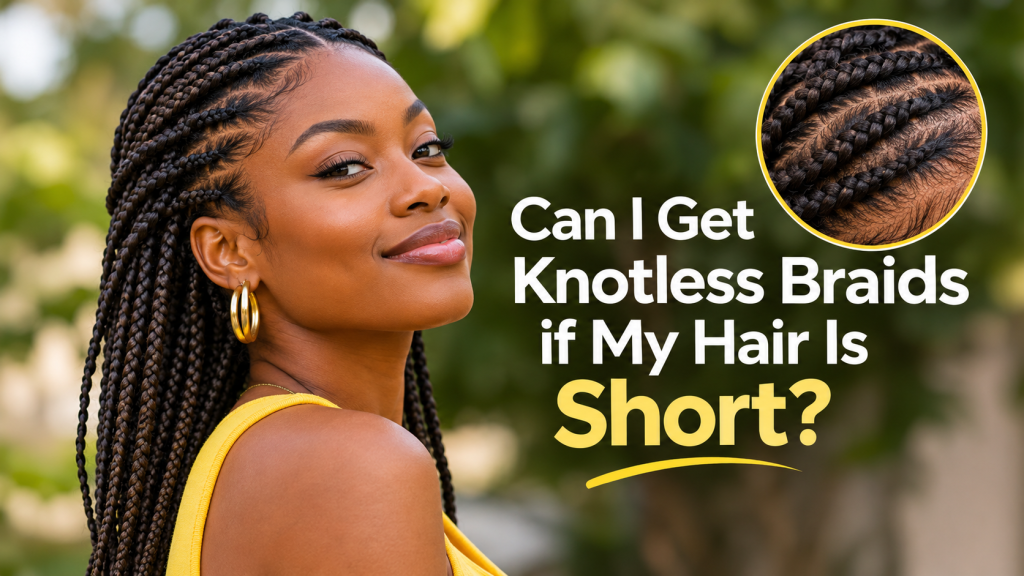
Short hair does not necessarily mean you have to wait months before considering braids. However, choosing a style involves more than finding someone who can grip the roots. Your natural hair needs enough length and strength to support the installation comfortably.
Knotless braids on short hair may be possible when a braider can start each section securely without excessive pulling. The answer depends on your actual length, the shorter areas around your hairline and nape, and the amount of extension hair you want to add.
A consultation is the most useful starting point. It allows your stylist to assess what your hair can support and recommend a finish that suits your current length, rather than forcing a reference photograph to work at any cost.
What Makes Knotless Braids Different?
Knotless braids begin with your own hair, with extension hair gradually fed into the braid. Traditional box braids commonly attach the extension with a knot at the base. The knotless method creates a flatter starting point and can feel less bulky at the roots.
However, the absence of a knot does not make an installation automatically gentle. Tight sectioning, too much added hair or repeated pulling around delicate edges can still create problems.
For short hair, the important question is whether there is enough natural hair to establish and maintain the braid without relying on uncomfortable tension. Our guide to protective hairstyles that actually protect your hair explains why the technique and maintenance matter as much as the style itself.
How Long Does Your Hair Need to Be?
There is no single minimum length that guarantees a suitable knotless installation. Published guidance varies: Curl Centric’s knotless-braid guide discusses starting lengths around two inches, while Carol’s Daughter’s installation guide suggests three to four inches. That is approximately 5–10 cm across the two guides, rather than one agreed standard.
Treat those measurements as consultation guidance, not confirmation that your hair is ready. A longer section at the crown does not compensate for fragile, much shorter hair at the temples.
With coily hair, gently stretched length may be more informative than how short the hair appears when dry. You do not need to straighten it simply to ask for advice. Share clear photographs of the front, sides and back, and explain any uneven growth or recent breakage.
What Your Stylist Needs to Assess
The Shortest Sections
Hair length is rarely identical across the whole head. You may have enough length at the top but less around the nape, or shorter sections following a haircut, colour service or previous damage.
These areas can determine whether the chosen pattern is practical. A stylist may adapt the sectioning, leave delicate edges free or suggest waiting before adding extensions. Pulling harder to capture every short strand is not a suitable solution.
Hair Density and Strand Condition
Fine strands and low-density sections may need a different approach from fuller areas. Hair that looks thick overall can still have delicate edges or weakened ends.
Tell your stylist about recent chemical services, heat damage, breakage or tenderness after previous braids. The assessment should consider how your hair feels and behaves, rather than relying only on a curl-type label.
The Length and Weight of the Extensions
A short natural base still carries the added hair attached to it. Very long braids, dense extensions and heavy accessories can increase the load on each section.
A shorter finished style with an appropriate amount of fibre may be more manageable, but suitability remains individual. More extension hair will not make a weak or slipping base stronger.
Which Braid Size Works Best on Short Hair?
There is no universally best size. Small braids use smaller sections, but each section must still support its extension comfortably. Jumbo braids use larger sections, which may be difficult to gather securely when the natural hair is very short or uneven.
Medium knotless braids may be worth discussing, but they are not automatically the right answer either. Your stylist should balance the section size, natural hair available and amount of fibre being added.
Also distinguish between short natural hair and short knotless braids. A photograph of a chin-length braided bob shows the finished braid length; it does not tell you how much natural hair the wearer had before installation.
Can I Get Knotless Braids on Short 4C Hair?
Possibly. Tightly coiled hair can appear much shorter because of shrinkage, so an assessment should consider its gently stretched length as well as its condition.
Preparation should focus on clean hair, suitable conditioning and careful detangling. A blow-dry is not automatically necessary for every appointment. Ask your stylist how they would like you to prepare and whether any stretching is needed for the proposed technique.
Avoid treating 4C hair as something that needs stronger pulling or aggressive brushing to make braiding possible. The installation should work with your texture and remain comfortable throughout.
When It May Be Better to Wait
If the hair repeatedly slips before the braid is established, or the stylist needs to pull tightly to hold it, waiting may be the better option. The same applies when your scalp is sore or your hairline is recovering from breakage.
The American Academy of Dermatology’s guidance on preventing extension-related damage emphasises protecting natural hair and avoiding painful installations. Being able to complete a braid does not mean the resulting load is appropriate for that section.
Depending on your length, you could discuss loose twists, an adapted flat-twist style or wearing your natural texture while shorter areas grow. These options also need gentle handling. Persistent thinning, sores or unexplained hair loss should be assessed by a healthcare professional.
How to Prepare for Your Appointment
Send a photograph of your current hair alongside the style you want. Mention any recently shaved areas, an undercut, fragile edges or uneven lengths so the braider can give more useful initial advice.
Confirm whether washing, detangling, stretching and extension hair are included in the booking. Arrive with your hair prepared according to the salon’s instructions, and avoid loading it with heavy products immediately before the appointment.
Ask what changes might be needed if the reference style is unsuitable. Agreeing on a lighter or shorter option beforehand is easier than deciding after installation has started.
Caring for Knotless Braids on Short Hair
Shorter natural ends may become visible or work loose as the style is worn. Some frizz is normal, but ongoing slipping, pulling or discomfort deserves attention. Avoid trying to fix every loose section with strong gel or repeated tightening.
Keep your scalp clean, rinse cleansing products thoroughly and let the roots and braids dry properly. Use suitable moisturising care and protect the style at night with a comfortable satin scarf, bonnet or pillowcase.
Agree on a review and removal plan with your stylist rather than assuming every installation should last the same number of weeks. Our article on when to refresh a protective hairstyle explains what to monitor between appointments.
Signs Your Braids Are Too Tight
Pain, stinging, a pulling sensation and bumps around the hairline should not be accepted as the price of a neat finish. Tell your stylist immediately if a section feels uncomfortable.
The American Academy of Dermatology explains that repeated tension can cause traction alopecia. A painful style needs loosening or removal rather than waiting for the roots to grow out.
Avoid putting fresh braids into a tight ponytail or bun. If discomfort continues after adjustment, or you notice thinning or scalp inflammation, seek medical advice.
Frequently Asked Questions
Is 5 cm of Hair Enough for Knotless Braids?
It may be enough for some installations, but it is not a guarantee. The shortest sections, density, condition and planned extension weight all need assessment before confirming suitability.
Can Knotless Braids Damage Short Hair?
Yes, if the installation is too tight, too heavy or poorly maintained. A knotless start does not remove the need to protect your scalp and hairline.
Will Knotless Braids Make My Hair Grow Faster?
No. They do not increase the biological growth rate. Gentle installation and maintenance may help reduce breakage and support length retention, but results are not guaranteed.
Should I Choose Box Braids Instead if My Hair Is Very Short?
Not automatically. A different attachment method does not make fragile or very short hair ready for extensions. Ask your stylist which option, if any, your hair can comfortably support.
Choose a Style Your Hair Can Support
The best result starts with an honest assessment of your current hair. Enough length to grip is only one part of the decision; comfortable sectioning, suitable extension weight and ongoing care matter too.
If you are considering knotless braids in Hartbeespoort, view Bangs & Butch’s braids and twist services or request an appointment